
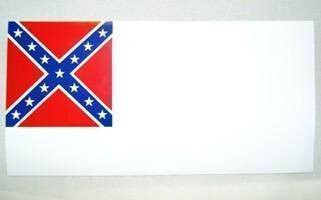
2nd National Confederate Flag - Stainless Banner
The Second National Confederate Flag — known as the Stainless Banner — was adopted on 1 May 1863, replacing the Stars and Bars. It places the Confederate Battle Flag of the Army of Northern Virginia in the canton on a pure white field.
Why it was called the Stainless Banner
The name comes from the unbroken white field. Its designer, editor William T. Thompson of the Savannah Morning News, promoted it as "The White Man's Flag" — a description that reflects the politics of its creator and of the Confederacy, and which is part of why the design remains contested today.
The first Stainless Banner ever sewn was used to drape the coffin of General Thomas "Stonewall" Jackson as he lay in state at the Confederate Capitol in Richmond in May 1863, days after the flag's adoption. That association is a large part of why the flag is remembered at all.
The problem with the design
In still air the banner hung as a largely blank white rectangle, and on the battlefield it was repeatedly mistaken for a flag of truce or surrender. Confederate naval officers complained about it in particular, since at sea a limp flag was often all another vessel could see.
That flaw led directly to the Third National Flag in March 1865, which added a vertical red bar at the fly end specifically to prevent the confusion. The Stainless Banner therefore flew for less than two years — one of the shortest-lived national flags in American history.
Stainless Banner variants
The 1863 specification called for a field twice as long as it was wide, but wartime production varied widely. Surviving originals and reproductions differ in proportion, in the size of the canton relative to the field, and between army and naval patterns — the naval version is notably shorter and wider.
Our Stainless Banner flags
We stock the 2nd National in outdoor nylon (printed and embroidered), historically accurate cotton for re-enactors and collectors, stick flags, and smaller indoor and desk sizes. Several are made in the USA — look for "Made in USA" on the product. For re-enactors we also carry antiqued and tea-stained finishes that read as period-correct rather than new.
See also the First National (Stars and Bars), the Third National, and the Confederate Battle Flag.