
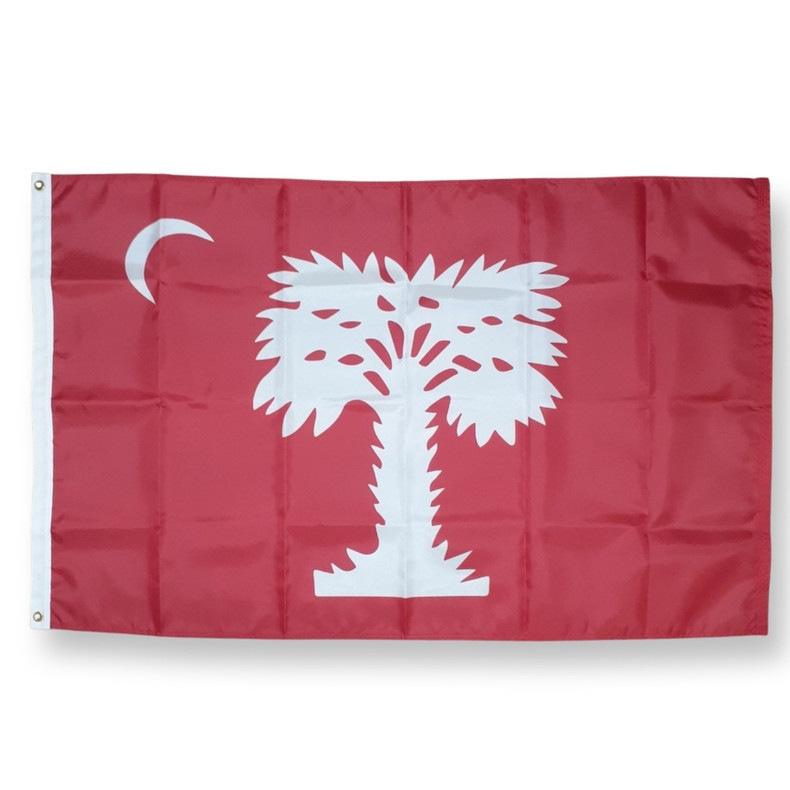
Long before South Carolina’s blue state flag became familiar across the country, a striking red banner carrying a white palmetto tree and crescent appeared over Charleston Harbor. Today it is commonly known as Big Red.
Its bold design makes it immediately recognizable, but the history behind the flag is even more compelling. Big Red is connected to the tense weeks after South Carolina’s secession, the confrontation involving the Star of the West, the closing battles of the Civil War, and an extraordinary journey from South Carolina to Iowa and back again.
A red palmetto flag for the defense of Charleston
South Carolina seceded from the Union on December 20, 1860. In the weeks that followed, state forces strengthened positions around Charleston Harbor while the United States garrison remained at Fort Sumter.
According to historical research assembled by The Citadel and its alumni organizations, a large red palmetto flag was presented for use at Fort Morris on Morris Island. The flag is associated with Hugh E. Vincent, a South Carolina military cadet and flag maker whose name appears in accounts of several early secession-era banners.
The design was simple and dramatic: a white palmetto tree and a white crescent on a red field. One of its most important identifying details is the direction of the crescent. On the surviving historic flag, the crescent opens toward the palmetto tree. Later reproductions and illustrations have not always preserved that feature.
Big Red and the Star of the West
On January 9, 1861, the merchant steamship Star of the West entered Charleston Harbor carrying soldiers and supplies intended for Fort Sumter. Cadets manning a battery on Morris Island fired on the ship, which turned back without reaching the fort.
The incident occurred months before the bombardment of Fort Sumter formally opened the Civil War. For that reason, the shots fired at the Star of the West are often described as among the conflict’s earliest hostile shots.
Historical accounts place the red palmetto flag above the Morris Island position that morning. This connection transformed an unusual South Carolina banner into a witness to one of the most consequential moments in the harbor’s history.
South Carolina did not adopt its familiar blue state flag until later that month. On January 28, 1861, the General Assembly approved a design combining the palmetto tree with the crescent on a blue field. Big Red therefore belongs to a brief but fascinating period when South Carolinians used several variations of palmetto and secession flags.
From Morris Island to Mobile Bay
How the original flag traveled during the war is not documented at every step. Researchers have developed a likely chain of events from surviving records, physical evidence, and the history attached to the flag, but portions of that journey remain an informed interpretation rather than an unbroken paper trail.
The flag is believed to have gone west with South Carolina troops and later to have been carried by Culpeper’s Battery. At Fort Blakeley, Alabama, Union forces attacked Confederate defenses on April 9, 1865—the same day General Robert E. Lee surrendered the Army of Northern Virginia at Appomattox.
Private Willard Baker of the 20th Iowa Infantry was credited with capturing a large red palmetto flag during the fighting at Fort Blakeley. Decades later, in 1919, Baker donated the flag to the State Historical Society of Iowa.
There it remained for generations.
The flag in Iowa
The surviving banner is an imposing object, measuring approximately seven by ten feet. It is made from red wool bunting with a white cotton palmetto and crescent—materials and construction consistent with a large nineteenth-century garrison flag.
Researchers from South Carolina examined the Iowa flag, compared its construction and design with the historical record, and assembled the findings in a detailed 2009 report. That work supported the identification of the Iowa artifact as the flag associated with Morris Island and the Star of the West incident.
The evidence is persuasive, but responsible history also preserves the limits of the record. The flag’s full wartime path cannot be proved with certainty. Its identification rests on the combined strength of its provenance, physical characteristics, design, and the historical circumstances surrounding its capture.
That uncertainty does not diminish the story. It shows how historians reconstruct the past: one document, artifact, and comparison at a time.
Big Red comes home
On October 16, 1992, Big Red was adopted as the official spirit flag of the South Carolina Corps of Cadets. The modern flag draws on the historic red field, white palmetto, and inward-facing crescent connected with the Morris Island banner.
The original Iowa flag returned to Charleston on loan in March 2010, nearly 150 years after the events that made it famous. Its homecoming brought together alumni, historians, preservationists, and members of the public who had followed the effort to identify and conserve it.
Today, Big Red is more than an alternate palmetto design. It is a visual link between South Carolina’s flag-making traditions, the history of Charleston Harbor, and the careful work required to preserve an artifact whose journey crossed battlefields and generations.
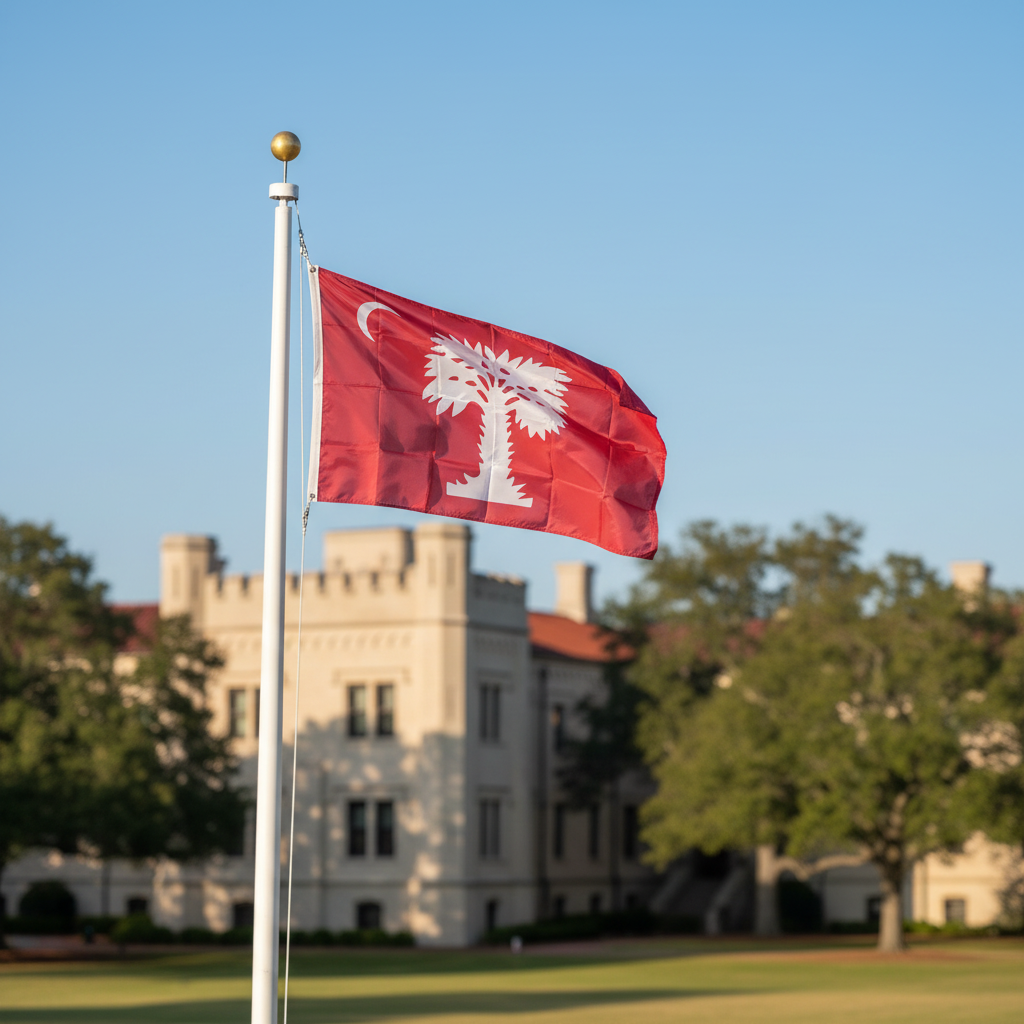
How to recognize a Big Red flag
The classic design has three defining elements:
-
A solid red field
-
A white palmetto tree
-
A white crescent opening inward toward the tree
That inward-facing crescent helps distinguish the historically researched design from many later interpretations.
Shop South Carolina Big Red flags
For collectors, South Carolina history enthusiasts, and anyone who appreciates distinctive palmetto designs, we offer Big Red flags in several constructions:
See all South Carolina Big Red flags.
Products are independently sold historical and commemorative flags. No institutional affiliation, sponsorship, or endorsement is implied.